
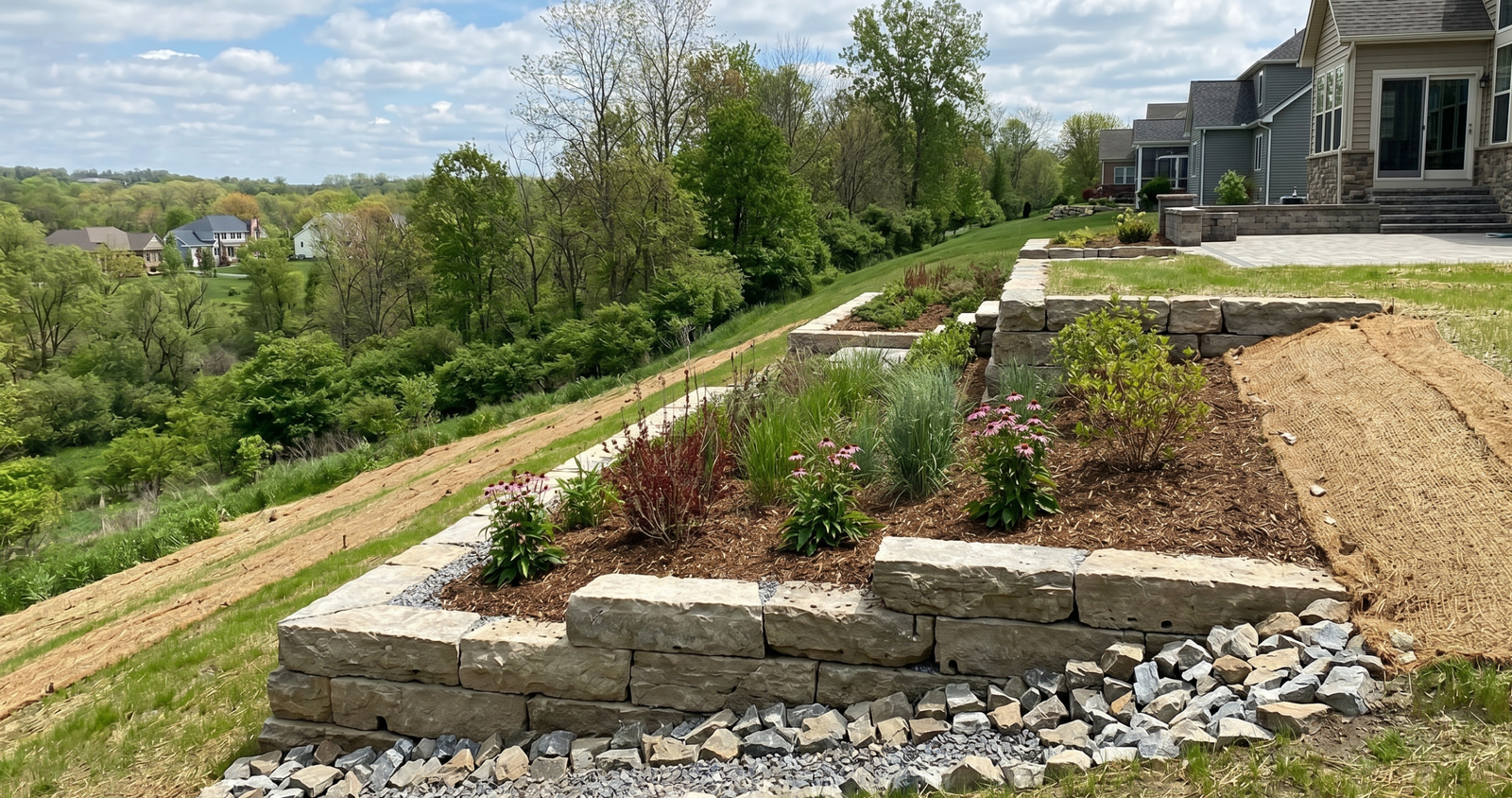
Managing a sloped property in Western New York comes with its own unique set of rewards and structural challenges. Whether your property overlooks the limestone features near the Onondaga Escarpment, sits along the rolling hills near Clarence Center, or borders the stream corridors of Ransom Creek, dealing with sloped terrain means actively managing stormwater runoff. Without adequate soil stabilization, Western New York’s heavy spring rains and intense winter freeze-thaw cycles can quickly turn a beautiful backyard hillside into an unstable, muddy mess.
Implementing professional erosion control for sloped landscapes in Clarence is about more than just keeping dirt in place; it is a critical step in preserving your property value, protecting local watersheds, and maximizing the usable square footage of your outdoor living space.
Frequently Asked Questions
Q: How do I know if my hillside slope requires professional erosion control?
A: Look for telltale warning signs such as exposed tree roots, widening mud channels or rills in the lawn, pooling water at the base of the hill, or a noticeable shifting of soil after heavy spring rains. If you notice structural tilting in nearby fences or garden walls, the hillside requires immediate professional stabilization.
Q: Can I just plant standard lawn grass to stop erosion on a steep hill?
A: Generally, no. Traditional turf grass has a very shallow root system, typically extending only two to three inches into the earth. While it works well on flat terrain, it lacks the structural depth required to anchor heavy, saturated soil on a steep slope during a major rain event.
The Core Challenge: Understanding Sloped Soil Erosion in Western New York
When rain falls on flat ground, it moves relatively slowly, filtering naturally into the earth. However, when gravity gets involved on a hillside, that same water accelerates, gaining kinetic energy. This fast-moving water shears topsoil away, creating unsightly rills (small channels) that eventually widen into deep gullies.
In the Town of Clarence, this natural process is accelerated by three distinct local factors:
- The Freeze-Thaw Cycle: The harsh Western New York winters cause the water trapped within the soil to freeze and expand, loosening the ground structure. When the spring thaw arrives, this unanchored soil is highly susceptible to being washed away by heavy seasonal rains.
- Local Soil Compositions: Many neighborhoods in Clarence feature a mix of dense clay subsoils topped with a thin layer of organic loam. Clay has notoriously poor drainage properties. Once the top layer of soil becomes saturated, excess water pools on the surface and flows downhill rapidly.
- Environmental Regulations: According to the Town of Clarence Town Code (Article VII, § 93-23/24), local property owners are legally required to maintain surface stability and protect topsoil depths. Property alterations must prevent silt and sediment from drawing into public highways, neighboring properties, or local aquatic ecosystems like the Tonawanda Creek watershed.
Frequently Asked Questions
Q: Why does the freeze-thaw cycle make erosion worse in Clarence?
A: When moisture in our dense clay soils freezes during winter, it expands and pushes soil particles apart, a process known as frost heave. When it thaws in spring, the soil is left completely loose, fluffy, and disconnected, making it incredibly easy for early spring rainstorms to wash it away before plants wake up from dormancy.
Q: Are there local permits required for grading a slope in the Town of Clarence?
A: Yes. The Town of Clarence actively monitors clearing and grading to protect local drainage infrastructure and watersheds. Any major alteration to your property’s topography or drainage patterns requires a clearing and grading permit through the Town Building and Engineering Department to ensure compliance with local stormwater regulations.
4 Proven Engineering & Design Solutions for Hillside Stabilization
Remediating a shifting hillside requires an integrated approach that balances heavy hardscaping with strategic softscaping. Depending on the severity of the pitch, a professional landscaping plan will generally utilise one or more of the following proven methods.
1. Structural Retaining Walls
For severe slopes (pitches greater than 30 degrees), structural retaining walls are the definitive solution. By cutting into a hillside and building a solid vertical barrier, you effectively transform a steep, unusable incline into flat, functional terraced levels.
Original Slope Outline: \
Terraced Solution: |_____|_____|_____
[Wall] [Wall] [Wall]
To withstand the lateral earth pressure and the expansion of freezing ground in our region, retaining walls must be engineered with heavy-duty materials, such as interlocking concrete segments (like Belgard systems) or natural New York limestone blocks.
Expert Insight: The wall itself is only half the battle. A truly resilient retaining wall requires a properly designed internal drainage system. This includes backfilling with crushed clean stone and installing a perforated schedule 40 PVC drain tile (weep holes) behind the wall. This ensures that hydrostatic water pressure builds up safely behind the structure and drains away, preventing the wall from bowing or collapsing during winter freezes.
2. Deep-Rooted Native Plantings (Softscaping)
For minor to moderate slopes, nature provides the most efficient anchoring system available. While traditional turf grass has incredibly shallow roots (often only two to three inches deep), native New York perennial plants grow deep, complex root networks that act like an underground web, stitching the soil matrix together.
When designing a planting plan for a Clarence hillside, we focus on hardy, native varieties capable of enduring saturated spring soils and dry mid-summer spells:
- Shrubs: Red Osier Dogwood (Cornus sericea), Fragrant Sumac (Rhus aromatica), and Arrowwood Viburnum.
- Perennials & Grasses: Switchgrass (Panicum virgatum), Little Bluestem, and Purple Coneflower.
3. Biodegradable Erosion Control Blankets
When establishing new vegetation on a slope, seed mixes are highly vulnerable to washing away before they can germinate. To prevent this, professionals utilise heavy-duty erosion control blankets made of natural coconut coir (coir mats) or straw or jute netting. These mats are pinned firmly to the graded hillside, holding the seed and topsoil securely in place. Over the course of two to three seasons, the blankets naturally biodegrade, leaving behind a fully established, self-sustaining root system.
4. Riprap and French Drains
If your sloped property features a natural swale or depression where water naturally aggregates during heavy storms, planting vegetation may not be enough. The sheer velocity of the water will rip plants out by their roots. In these high-velocity zones, installing a French drain (a fabric-wrapped stone trench containing a perforated pipe) redirects subterranean water away from the hillside safely. On the surface, lining the channel with riprap—a layer of large, angular stones—slows down the velocity of flowing water and dissipates its erosive energy.
Frequently Asked Questions
Q: How high can I safely build a retaining wall on my property?
A: In most local municipalities, including Erie County, retaining walls under 4 feet tall can be built without an engineered design. However, any wall exceeding 4 feet in height requires a structural engineer’s stamp and a formal building permit because the immense weight of the earth behind it creates severe structural risks if built incorrectly.
Q: Do biodegradable erosion control blankets need to be removed after the grass grows?
A: No, they do not. Blankets made from jute, straw, or coconut coir are specifically designed to decompose naturally into organic matter over a period of 12 to 36 months. By the time the mat breaks down, the root networks of your new native plantings will have completely taken over the job of holding the hill together.
Comparing Sloped Landscape Solutions
| Method | Best Suited For | Key Benefit | Maintenance Level |
| Retaining Walls | Severe inclines, creating usable flat lawn space | Maximum structural stabilization | Very Low (Inspect drainage annually.) |
| Native Plantings | Gentle to moderate slopes, eco-conscious yards | Enhances biodiversity, natural aesthetics | Low to Medium (Weeding during establishment) |
| French Drains & Riprap | Drainage swales, low points, heavy runoff zones | Redirects high-volume water safely | Low (Keep rock paths clear of debris.) |
| Coir Matting | Newly seeded slopes, temporary stabilization | Protects young roots during early growth | None (Biodegrades naturally) |
Frequently Asked Questions
Q: Can I combine multiple erosion control methods on a single hillside?
A: Absolutely. In fact, the most successful erosion control projects are integrated systems. A common approach is building a structural retaining wall at the base of a severe slope to handle heavy loads, while using native plantings and coir mats on the gentler upper portion of the hill to save on overall construction costs.
Q: Which option is the most budget-friendly for a large sloped property?
A: Utilizing biodegradable erosion blankets paired with native hydroseeding or deep-rooted bare-root shrubs is significantly more cost-effective than hardscaping. Retaining walls require extensive excavation, gravel base preparation, and heavy materials, making them a premium, though highly durable, investment.
Why Professional, Local Expertise Matters
While DIY landscaping projects can be fun, heavy-duty erosion control on a slope is an engineering task that carries structural risks. A poorly constructed retaining wall or an incorrectly graded slope can back up water against your home’s foundation, wash away thousands of dollars in plants, or trigger structural damage to neighboring properties along your boundary lines.
Working with an established, fully insured Erie County landscape contractor ensures that your project complies with all local zoning codes and respects the unique regional environmental conditions. A professional team brings specialized hydraulic grading equipment, advanced soil-testing tools, and deep regional knowledge to construct a custom solution tailored explicitly to your property’s topography.
Frequently Asked Questions
Q: What qualifications should I look for in a Clarence landscape company for a sloped project?
A: Ensure the contractor holds comprehensive commercial liability insurance, carries worker’s compensation, and possesses verified experience with hardscape engineering. Look for certifications from organisations like the Interlocking Concrete Pavement Institute (ICPI) or a solid track record working directly with local Town of Clarence building inspectors.
Q: How long does a typical hillside stabilization project take to complete?
A: Minor softscaping and drainage installations can take anywhere from 1 to 3 days. Major terraced projects involving tiered concrete retaining walls require heavy excavation and structural assembly, typically taking 1 to 2 weeks depending on weather conditions and property accessibility.
Finding Sloped Stabilization Professionals Near Me
When dealing with shifts in structural terrain, proximity matters. You need a responsive team that is intimately familiar with the geographical layout, soil behaviours, and strict residential codes of the local area.
Our specialized landscape crew services properties throughout the entire region, providing immediate, high-calibre engineering assessments to homeowners in:
- Clarence (14031) — Comprehensive slope levelling near Main Street, Sheridan Drive, and the hollows.
- Clarence Center (14032) — Runoff management and grading for properties near the residential centres.
- East Amherst (14051) & Amherst (14221) — Correcting drainage issues along shared suburban boundaries.
- Williamsville (14221), Harris Hill, and Swormville — Constructing tier-one structural retaining walls along variable residential elevations.
Frequently Asked Questions
Q: Do you offer free on-site consultations for erosion issues in the Clarence area?
A: Yes. Because every slope possesses distinct hydrological and structural traits, an on-site evaluation is standard practice. Technicians examine your yard’s unique pitch, soil quality, and existing drainage vectors before building a custom layout estimate.
Our Location & Service Footprint
Protect and Transform Your Sloped Property
Do not let heavy rains erode your piece of Clarence. Transforming a problematic, shifting hillside into an attractive, multi-tiered feature asset protects your home’s structural foundation while providing your family with beautiful, functional outdoor living spaces to enjoy for generations.
Are you ready to stop erosion on your sloped property? Contact our local landscape design and build team today to schedule an on-site topographic evaluation and discover the ideal stabilization plan for your yard.